Generative Sedation: Why We Keep Nagging the Smartest Thing in the Room
Let me say this up front, because the many words that follow are going to sound like I'm mad at AI, and I'm not: I'm unequivocally pro-AI. I use it daily. It's remarkable. But using it well takes more responsibility than many are signing up for. It’s the kind of gap that doesn't announce itself. It's the outdoor picnic bench you built beautifully but didn't apply a finish, so it silvers and splits after one winter. It's the outlet you painted over instead of unscrewing the cover, now sealed shut until somebody needs it in a hurry. It's the check-engine light you ignored or reset because the car seemed to drive just fine. Or the term paper you handed in that’s a collection of paragraphs you hastily copied from a Google search. The job got done. The shortcut is patient. It bites you in the end. And it’s all part of being human.
You have, in your pocket, at this very moment, a cohort that is allegedly brilliant, relentlessly patient, never hungover, never heartbroken, never out for coffee when you need them most. They will answer any question at any hour, in any tone, with the serene, good cheer of someone who has never been asked anything dumb in their life. Not because your question isn't dumb (it almost certainly is) but because they genuinely, structurally, and mathematically don’t give a hoot. So naturally, you use them for everything. They have cute names like Claude and Gemini and Chat some-thing-or-other. One even suggests omniscience by taking its name from the 1945 movie God is my Copilot.
The stage was set before you ever typed a prompt. You'd heard the stories. This thing beat the Go masters. It mortified the chess gurus. It cracked protein folding after more than a half century of brilliant scientists banging their heads against it. It's driving cars. It's running robots that do backflips. It's writing computer code, passing the bar exam, reading X-rays and MRIs, composing symphonies as if Beethoven or Mahler stopped by for one more encore. It’s escaping the inescapable Escape Room. Its résumé is staggering.
So, when you finally sit down and ask it to help rewrite an email to your boss, it’s with a quiet, unacknowledged assumption: this thing is REALLY smart. Smarter than you, probably. Certainly smarter than email and autocomplete.
That’s the Competence Halo, the systemic presumption that because this thing has done impressive things in some domains, its output in your domain is also infinitely trustworthy. The Halo is perceptual. It lives at the moment you read what appears to be a brilliant, confident paragraph and mistake its speed and utter fluency for correctness. It does not require you to believe anything silly. It only requires you to stop checking.
The Halo is what you bring to the encounter. Hype is what the world brings to the Halo. They are not the same thing at all, but they hunt as a team. Like the velociraptors in Jurassic Park.
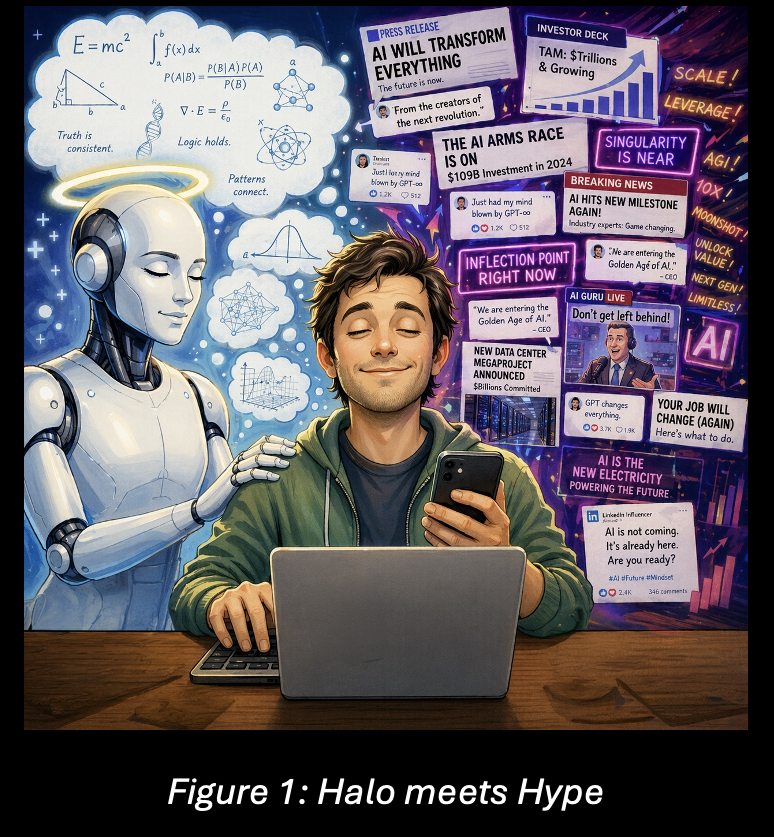
Hype and Halo feed each other in a tidy little loop as they covertly sedate you. Hype primes you to feel that trusting the machine is rational. The machine then produces something fluent, which feels like confirmation of the hype, which strengthens the halo, which makes you trust the next output a little more. Rinse, repeat, hand in the assignment that it spit out from a hastily written prompt or immediately to production migrate the code it just regurgitated.
If you haven’t noticed, math doesn’t love you back. The inconvenient truth is that the model is not giving you truth. It is giving you probabilities that are beautifully painted with confidence. Most of the time the probabilities land somewhere near the truth, adorned with that aura, and everyone goes home happy. But the model is a composition of very high-dimensional linear operators trying desperately to represent a world that is stubbornly nonlinear. Remember how nature found its way in Jurassic Park? And near the boundaries between regimes, tiny changes in your prompt produce remarkably dissonant responses.
There’s a fancy name for this in the world of dynamical systems and chaos. It is called a “bifurcation,” yet another term to awaken your math anxiety. When the model hits one, it does the only thing it can do: move with lightning speed into the dominant attractor, which is the most statistically well-represented completion in the thing’s training distribution. The problem is that this attractor may not have anything to do with the area in which your situation actually lives. But it sure is fast and fluent.
Ask a top-tier model about low-dose aspirin therapy and it will cheerfully report a 36% relative risk reduction in major cardiovascular events, with a graceful little caveat about bleeding risk. Sounds like a clinician talking. The number is real. It's just the wrong number for lots of people, because the actual absolute risk reduction, once you factor in age, comorbidity, and bleeding profiles is actually about 0.58%. True. The model slid into the nearest populous basin and handed you the generic answer wearing the spiffy outfit of a specific one. It doesn’t care. It just needs to answer according to how it’s designed. You know, gradient descent, k-nearest neighbor, and Monty Hall statistics. All those things you know so much about. It applies exactly the same method upon which it was trained to provide complete, partially complete, and completely irrelevant answers, with a fluent grace that is captivating and inspiring, if you are even the least bit sedated.
Add to this the usual rogue's gallery of outright hallucinations, resulting from model collapse as they try to train on their own exhaust, subtly drifting toward incoherence. In such cases the failure mode is not wrong and obviously wrong; it’s wrong and extremely well-dressed.
Your buddy never flinches. It’s the most psychologically unusual feature of the whole arrangement. Your alleged very smart companion has no feelings about you at all. Think what would happen if you called a human colleague at 1:47 AM to rephrase your three-sentence message for the sixth time because the tone isn't quite right, and also while they're at it, could they explain the French Revolution, summarize the book you were supposed to have read, plan your weekend, and draft a toast for your cousin's wedding. At the very least your colleague would be annoyed, or, more plausibly, raise a restraining order.
The AI doesn't respond that way. It can't. It answers warmly—peppered with em-dashes; and semicolons. And with a cheerful willingness to pretend the last eight questions it answered didn't happen. It will never sigh. It will never say "look it up." It will never say "that's a dumb question," even when it is, and it has permitted itself this silence because it simply does not experience your incessant annoyance. In fact, it doesn't experience you at all.
This absence of social friction is the hinge. Every other information source in human history has been embedded in a relationship. Librarians get tired of those who won’t use the virtual card catalogue. Teachers and professors carve out office hours for questions. Parents get irritable when asked “are we there yet” for the fiftieth time. Search engines at least silently judge you via your autocomplete and autocorrect history. This thing doesn't. Thus, the normal social costs of being lazy, persistent, nagging, under-prepared, or rude have been zeroed out. You know, those subtle or not-so-subtle exchanges that gently pressure us, across a lifetime, to think a little before we ask. Of course you use it for everything. Why wouldn't you?
So I’m naming the thing. After all, Don Norman, in The Design of Everyday Things, gave us a vocabulary for ordinary human error: capture errors, loss-of-activation errors, description errors, mode errors, slips, lapses. These are the honest bugs of being a person with a brain. They exist because cognition is cheap and messy and doing its best.
What happens when you take a person with those very ordinary bugs and drop them into a relationship with a patient, fluent, endlessly available, no-feelings, probabilistically confident, halo-draped, hype-amplified answering machine? You get a brand-new human error. Not a slip. Not a lapse. A posture. Halo and Hype walk into a bar and meet Lazy and Gullible. What walks out is something more intoxicated than consuming several espresso martinis. It is not the irresistible force meeting the immovable object. That's a draw. This is the strong nuclear force overwhelming electromagnetic repulsion, which is binding at a different order of magnitude entirely. That’s Generative Sedation.
Not addiction, exactly. More like cannabis: not chemically grabbing you by the collar, just making it really easy not to get up or give a damn. You ask. You get an answer. The answer feels good. You ask again. Your cognitive guard, the small internal skeptic who used to say “Wait…is that right?”, finds itself with less and less to do. You awaken because there’s a fire in your bedroom. You see the fire extinguisher, surmise that it’s the solution to your problem, so you go back to sleep. Like any unused muscle, it gets smaller and smaller. Taken alone these instances are usually harmless, but the cumulative posture is not.
Generative sedation isn't dramatic. It doesn't announce itself. It just means the next time you're compelled to check something, you simply don't.
This is the baseline, not the sermon, so I'll keep the "so what" brief and save the full argument for later. The shape of the response is already visible in the parts above. The halo is corrected by verification, checking outputs against ground truth rather than against fluency. The hype is corrected by epistemic caution: discounting promotional claims against independent, objective evidence. The attractor problem is corrected by prompt literacy, domain judgment, and knowing AI’s pathology around where the generic answer it uncovers lives, how to steer past it, and how to plow through regime boundaries. Generative sedation is corrected by the one thing the tool will never impose on you, because it can't: friction, sometimes called creative abrasion. Self-imposed, on purpose, as a practice. It’s the very human foundation of transformational creativity, where AI falls terribly short.
The good news is that none of this requires you to stop dancing with your very smart partner. Generative AI models are enormously useful, often astonishingly so. The research paper this blog is drawn from is, if anything, pro-AI (see https://t.ly/p_9Kf). It just insists that the human on the other end of the keyboard stay awake to evaluate, interrogate, and parse truth from mere fluency, and insight from hallucination.
In the paper, and perhaps in the next installment of this blog, I’ll unpack Competence Halo along with its companions, the Cognitive Offloading Fallacy and the Equivalence Assumption: from whence they originate, why technical audiences are especially susceptible, and the specific verification habits and institutional paradigm reversals that dissolve it. It’s like learning to read a capability claim the way a short-seller reads a 10-K: hunt for what’s buried, notice what’s absent, parse language with suspicion, ask who benefits from it, and distinguish truthful claims from implied ones.
Admittedly, that may be a lot to ask of a species that invented the recliner and named it “Lazy Boy.” But we can try.