

I've always been proud to say that D'Youville University was an early adopter of artificial intelligence. We were fascinated by it, excited about its potential, and most importantly, we saw the writing on the wall. AI wasn't going anywhere.
Like many institutions, our earliest conversations focused on productivity, content generation, and that ever-blurring line of academic integrity. Could AI help faculty develop instructional materials? Yep. I never want to create a rubric again. Could it make our jobs easier? Yep. I can build code for my Canvas class in an instant. And, of course, what were we going to do about students using it to write their papers? We weren’t going to ban it, so that was a sticky one.
These were all important conversations, but, as a glass half-full kind of girl, I knew there had to be more to explore. We were instructional designers, and my team and I were darn good ones. So instead of focusing entirely on what AI could do for us, what if we started thinking about what it could help our students do? As it turns out, that question would eventually lead us to DAISY. But I'm getting ahead of myself.
It Started with a Conversation. Literally.
Rewind to an April afternoon in 2024. I was working on a patient assignment for a clinical mental health counseling course. The challenge was familiar: how could we give students meaningful opportunities to practice professional skills before they were expected to demonstrate those skills in the real world? Traditional simulations and role-playing activities are incredibly valuable, but they also require time, coordination, and sometimes significant resources.
Looking for inspiration, I picked up my phone and decided to see what ChatGPT's voice feature could do. Heck, I had just programmed the voice to be British, so who wouldn’t want to play with that? And what if I asked my British AI butler to play the role of a patient? Interesting. A few minutes later, I found myself having a surprisingly natural conversation with an AI-generated patient, and it was authentically nerve-wracking. I knew this patient wasn’t real – but it FELT real!
Now, I won't pretend that I immediately recognized this as the beginning of some groundbreaking educational innovation. I was sitting at my desk, talking to my phone, and seeing what would happen. But I was intrigued. What if students could practice these conversations independently? What if they could make mistakes, try different approaches, and repeat the experience without needing another person to play the role?
Suddenly, this little experiment felt like it had much bigger possibilities. I didn't know it at the time, but I had planted a seed.
Sometimes All You Need Is a Phone
Our university president has consistently challenged our office, The Institute for Teaching Innovation, to create unique and innovative learning experiences, and our team takes that challenge very seriously. So, one day, while sitting in the president's office, I decided to show her what I had been experimenting with. I pulled out my phone and right at her conference table, on a whim, I created an AI patient and started conducting a patient assessment. No simulation lab. No specialized equipment. No elaborate setup. Just my phone, an AI patient, and a conversation happening in the president's office.
And that was exactly the point.
Here was an opportunity to create an interactive learning experience using technology students were already carrying around in their pockets. They could practice difficult conversations from their kitchen tables, rehearse patient interviews between classes, and reflect on their experiences before trying again.
Of course, we hadn't solved every challenge associated with experiential learning. The next step was figuring out how to make this educationally meaningful. And that would take more than my phone.
A Little Curiosity, a Lot of Collaboration
Through D'Youville's Institute for Teaching Innovation, we began to host faculty trainings targeting these AI-powered simulations. We held workshops where faculty experimented with the technology, developed scenarios, shared ideas, and helped us think critically about how these experiences could support student learning.
And this is where things really started to grow.
What I particularly enjoyed was that we weren't presenting a finished product. We were figuring things out together. Faculty brought their disciplinary expertise and instructional challenges. Our instructional design team brought a pedagogical perspective and a healthy curiosity about what was possible.
As we experimented, we began refining the simulations, adding parameters for the conditional release of information and creating a framework that could meet learning objectives in varied disciplines. As faculty brainstormed, the scenarios differed, but the underlying learning process was remarkably similar. Students needed foundational knowledge, opportunities to apply that knowledge, and time to reflect on their experiences. But what then? What about after the simulation ends?
What if Students Could Just Try Again?
One of the things I was most excited about was making these experiences repeatable. Traditional simulations often require coordinating schedules, people, and resources. But with AI, students could simply try again.
Imagine a student completing a patient interview, reflecting on their performance, and realizing they missed an important question. Rather than just writing about what they would do differently next time, they could actually do it differently. Right then and there. No additional scheduling…no additional simulation costs. Just another opportunity to practice.
And if the second attempt didn't go quite as planned? Well, there's always a third.
That became central to our work. Students would prepare, apply their knowledge, reflect, and use what they'd learned to inform their next attempt. Learning isn't linear. It's cyclical, and we built our model around that principle.
We accomplished a lot over the next year, including piloting the simulation in a few classes and presenting the idea at our university’s research day. But there was something missing. A name.
And Then There Was DAISY
Anyone who has seen my backpack, my workstation or the gardens outside my house will not be surprised. One day, I started thinking about how much our learning cycle resembled the growth of a flower. You start with a seed, and given the right conditions, that seed develops into a stem, blooms, and then produces new seeds that allow the process to begin again. We needed a name for our framework, and it turns out that the answer was tattooed to my ankle all along - DAISY.
Serendipitous? Maybe, but I'll admit that there's something particularly satisfying about finding an acronym that actually fits what you're trying to describe.
And so, DAISY - D'Youville's Adaptive Interaction Simulation Yielding Model - was born.
The name came after the learning cycle, but the metaphor gave us a way to communicate the educational philosophy we had developed together. At its core, DAISY follows four interconnected stages:
Seed → Stem → Bloom → New Seed
Students begin by building foundational knowledge, move into applying that knowledge through an interactive simulation, reflect on their experience, and use what they've learned to begin the process again.
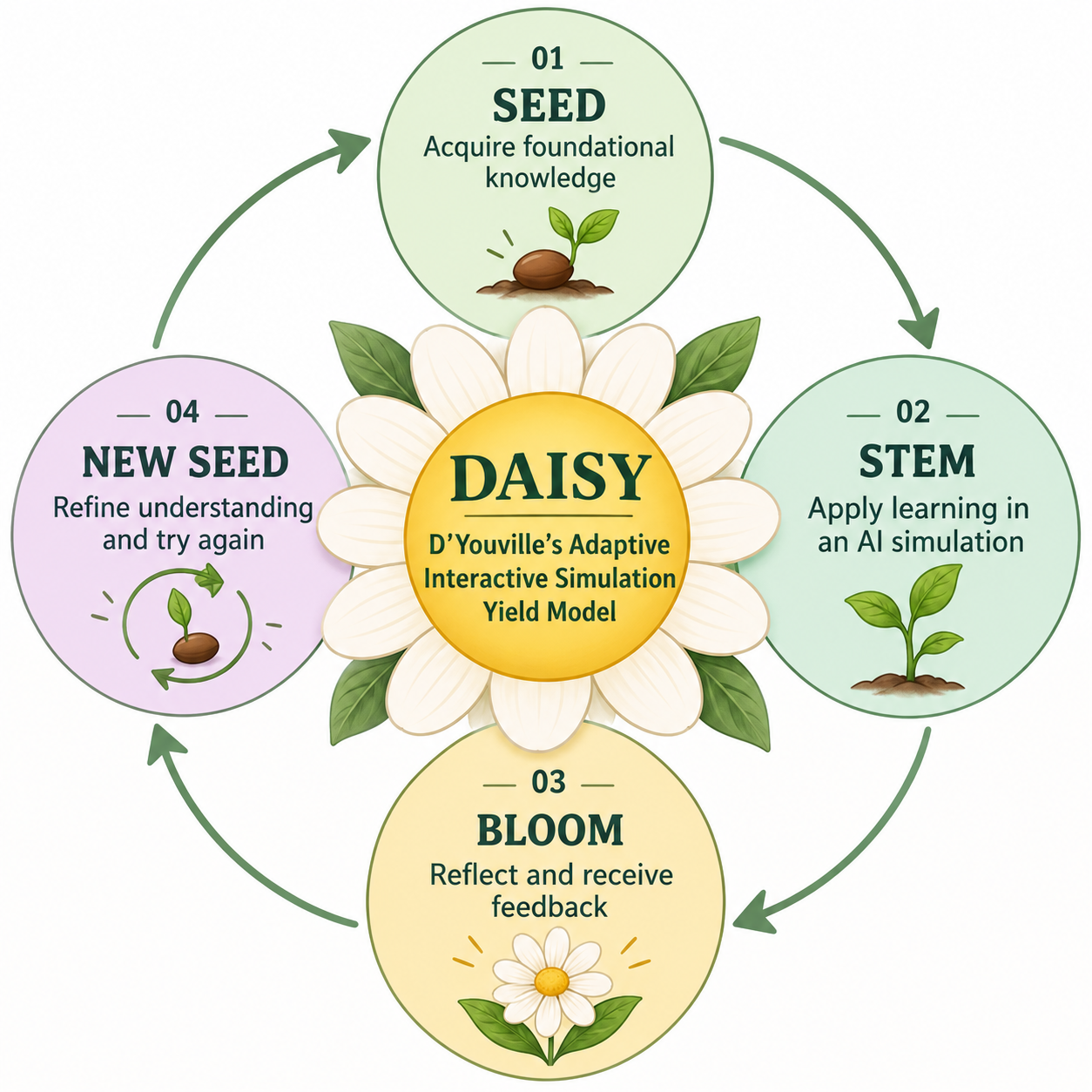
It's a relatively simple concept, but that's what I appreciate about it. The simulation provides the interaction, but the learning comes from what students do before, during, and after it. And perhaps most importantly, the cycle doesn't have to end.
It's Not Really About the AI
One of the most important things we've learned is that creating an interesting AI simulation and creating an effective learning experience aren't necessarily the same thing. It's entirely possible to develop an impressive simulation that accomplishes very little educationally.
That's where instructional design matters.
DAISY isn't the simulation itself. It's the educational framework surrounding it. The technology makes these interactions possible, but intentional instructional design gives them purpose.
That's also why our faculty partnerships have been so important. DAISY wasn't developed behind closed doors and handed off to instructors. It grew through collaboration and a shared commitment to student learning.
Although much of our early work has focused on healthcare education, the underlying approach has possibilities across disciplines, from leadership and conflict resolution to professional communication and decision-making. Different scenarios. Different disciplines. The same opportunity to practice, reflect, and grow.
When DAISY Reached Students
The true test of any educational innovation is not whether it works in theory, but whether it changes how students learn.
As faculty began implementing DAISY-based simulations, early student reflections suggested that these experiences were encouraging more deliberate attention, self-assessment, and reflection. One student reflected that interacting with the AI required them to focus more carefully on what was being said because they could not rely on visual cues or body language. Others described feeling surprisingly immersed in conversations with virtual patients, despite knowing the interaction was artificial.
Perhaps most importantly, students valued the opportunity to make mistakes, reflect, and try again. In a low-stakes, cost-free environment, they could experiment without the pressure of getting everything right the first time. What began as an experiment in AI-enhanced simulation had become something broader: an opportunity for deliberate practice, reflection, and growth.
We're Still Growing
One of my favorite things about DAISY is that it didn't begin with a grand institutional initiative or an elaborate research agenda. It started with a question, a little curiosity, and an afternoon playing with the British voice on ChatGPT.
I won't pretend we have it all figured out. DAISY remains in its early pilot phase, with much more to explore, refine, and evaluate. As our work progresses, we hope to examine more formally how students engage with these experiences and what they contribute to learning.
But that's a story for another blog.
For now, I wanted to share how DAISY came to be, because I think the process behind its development is just as meaningful as the framework itself. It's a reminder of what can happen when faculty and instructional designers have the opportunity to experiment, collaborate, and learn from one another.
Sometimes innovation doesn't begin with a fully developed plan. Sometimes it begins with a question. Sometimes it begins with a conversation. And sometimes it begins with an afternoon spent talking to your phone. You never really know which ideas will take root. But give them a little curiosity, collaboration, and room to grow, and you might just end up with a DAISY.
